ULTRAFIT NORTH USA
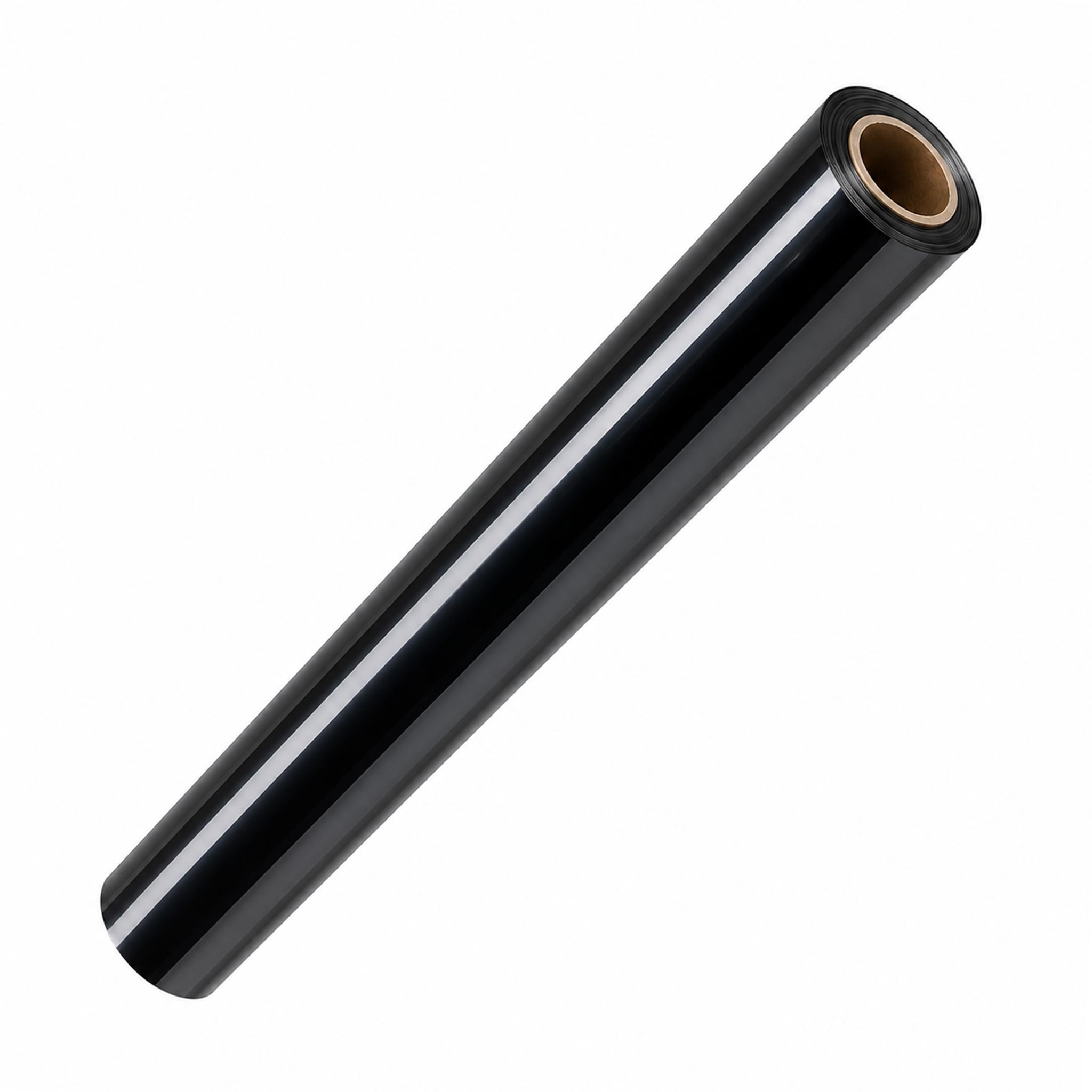
ULTRAFIT VF (Vivid Forte) Window Film
Choose options
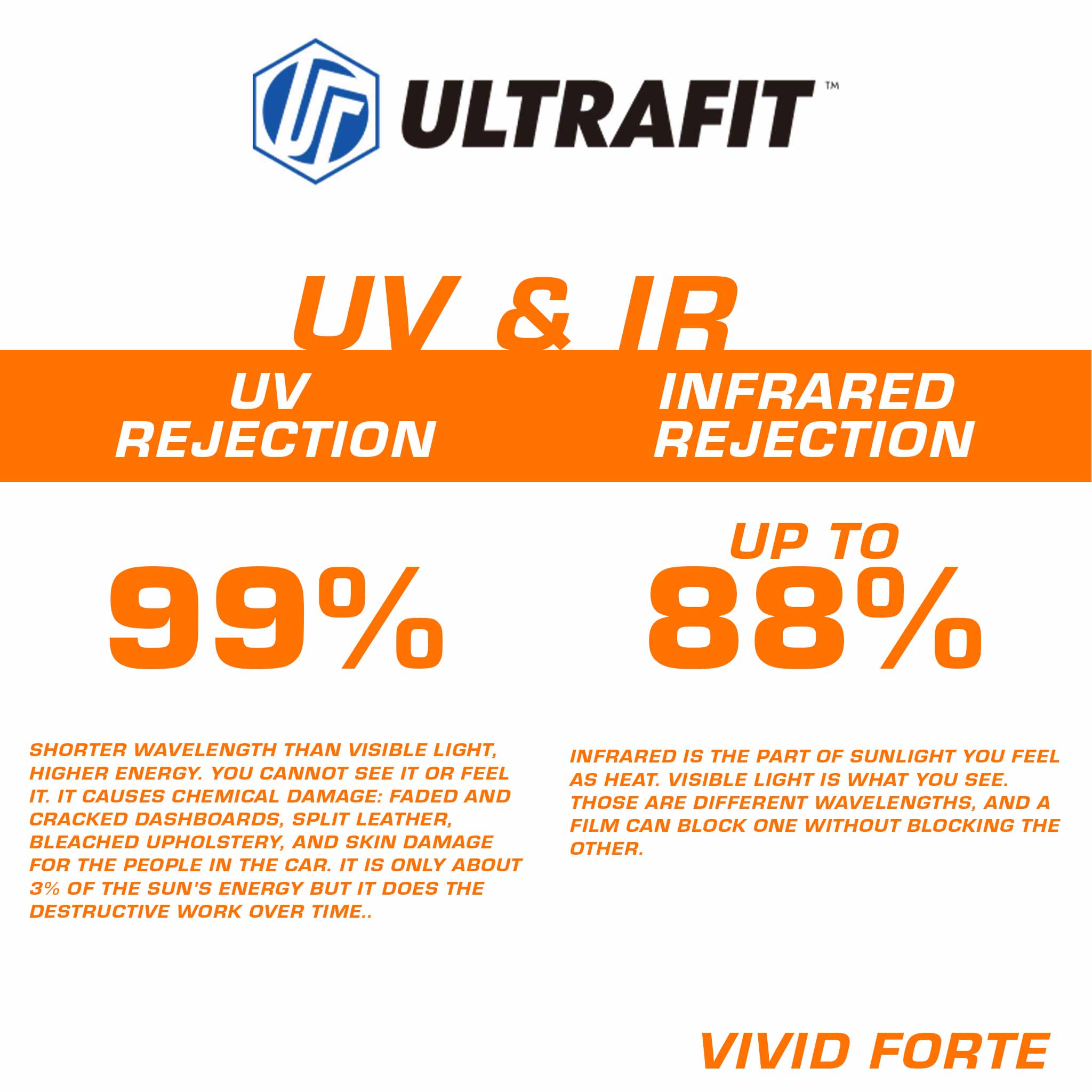
88% IR Rejection in Exclusive Smokey Navy
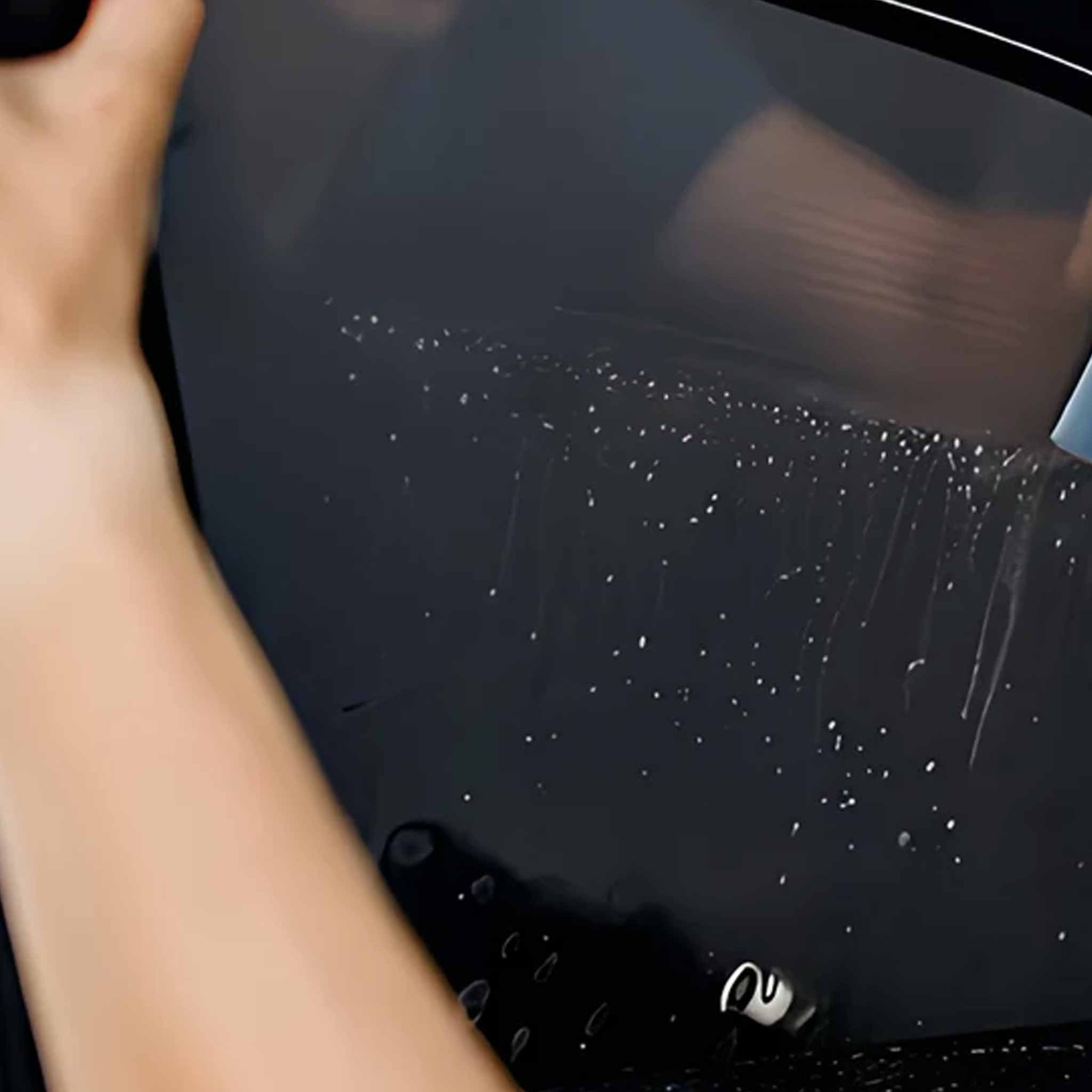
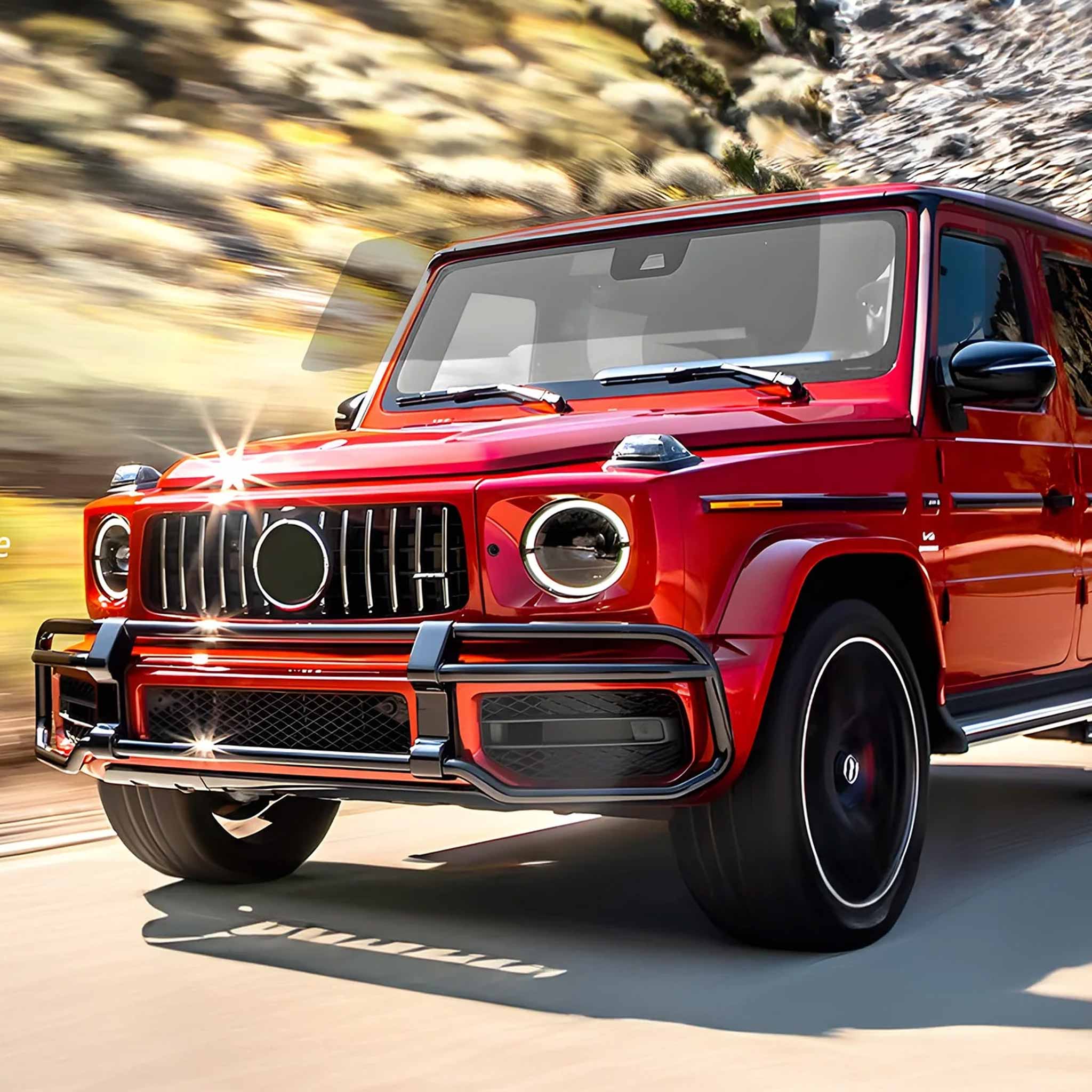
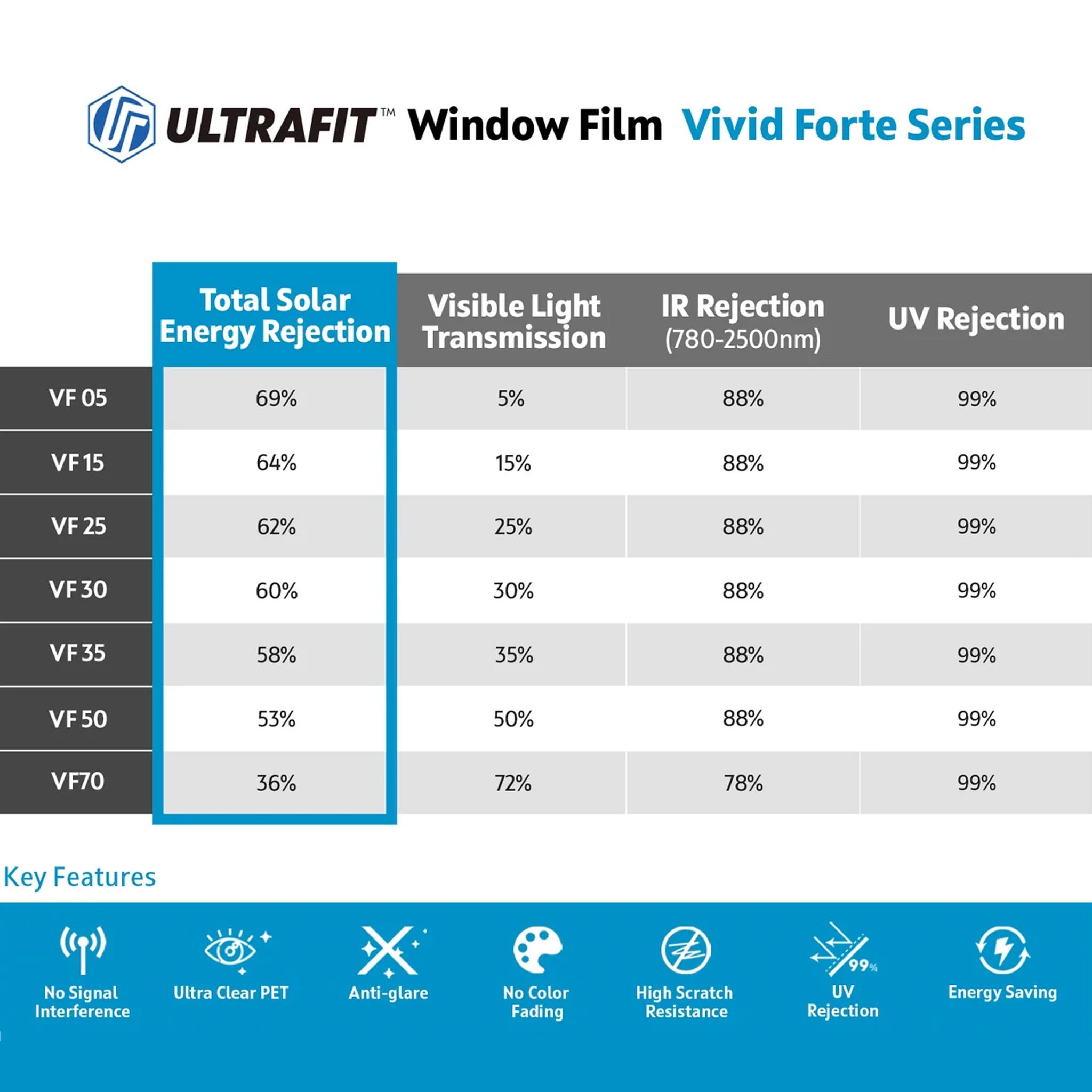
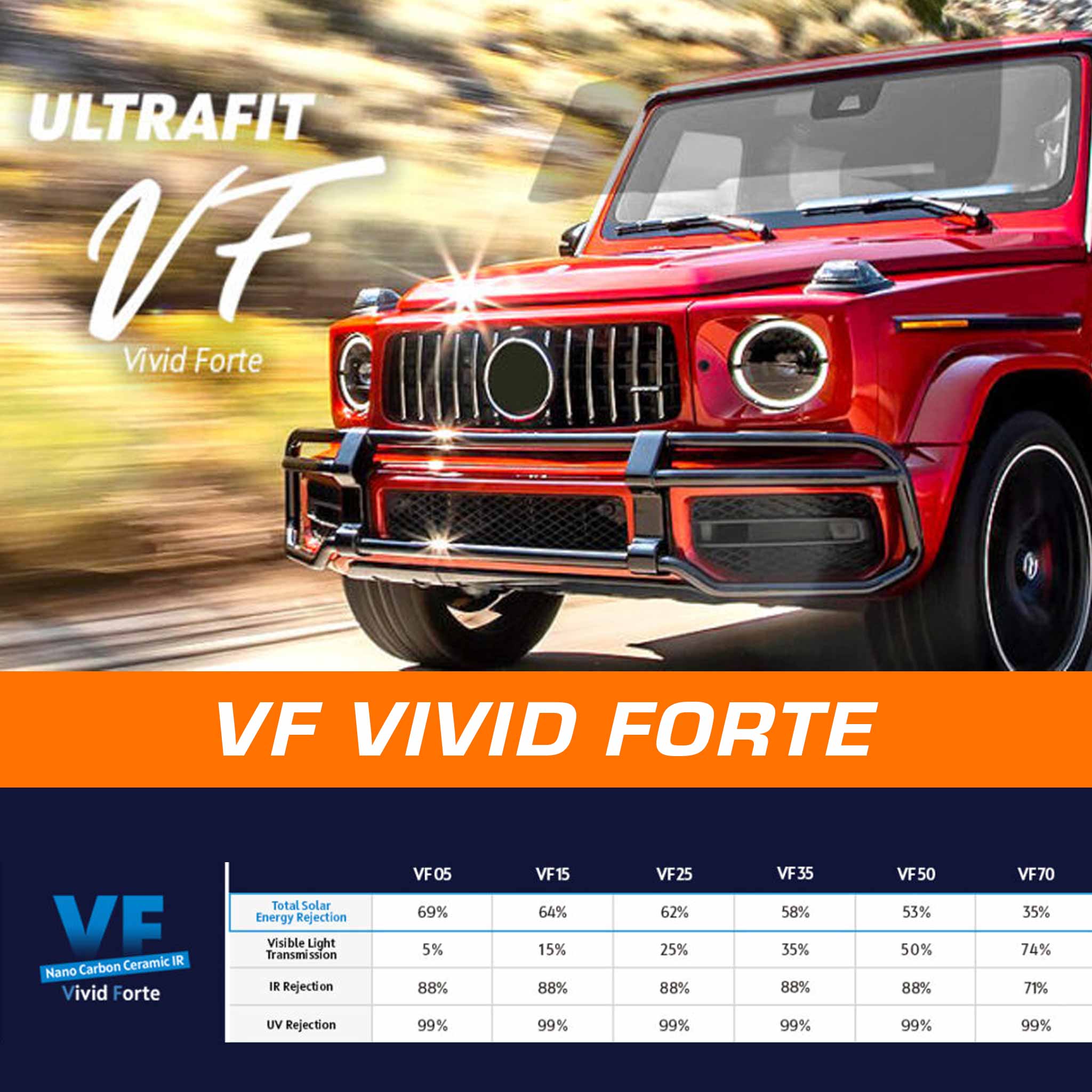
UltraFit Vivid Forte is the IR rejection window tint that balances serious heat performance against a look you cannot get anywhere else. It averages 88% rejection across the solar infrared spectrum from 780nm to 2500nm, the band where most solar heat actually lives, and carries a Total Solar Energy Rejection rating of 69, so the cabin stays cooler and the A/C stops fighting the sun. It also blocks 99% of UV radiation at every shade, protecting skin and keeping the dash, seats, and trim from fading. What separates VF from the rest of the Vivid Series is the exclusive Smokey Navy colorway, a sleek tone that reads richer than flat black on glass. Browse our window film and wrap supplies.
The construction is a hybrid, fusing nano carbon ceramic material with a metalized coating to push IR rejection higher while keeping visibility clear through the driver's line of sight. Vivid Forte comes in seven VLT shades, 05, 15, 25, 30, 35, 50, and 70, in 20, 40, and 60 inch rolls at roughly 2 mil thickness, and it carries a lifetime warranty for the original owner when installed by an authorized UltraFit dealer. Prep the glass with quality glass cleaners before install and keep sharp squeegees on the bench.
Features:
🌡️ Up to 88% IR Rejection: Averages 88% across the 780 to 2500nm infrared spectrum with a TSER rating of 69, cutting cabin heat and A/C load.
🎨 Exclusive Smokey Navy Colorway: A sleek navy-toned finish unique to Vivid Forte, giving glass a richer look than standard black films.
⚗️ Hybrid Ceramic Construction: Fuses nano carbon ceramic material with a metalized coating to raise IR rejection while holding clear visibility.
🛡️ 99% UV and Lifetime Warranty: Blocks 99% of UV at every shade, backed for the original owner when installed by an authorized UltraFit dealer.
Frequently Asked Questions
How much heat does Vivid Forte block?
It averages 88% rejection across the solar infrared spectrum from 780nm to 2500nm, with a Total Solar Energy Rejection rating of 69.
Where does VF sit compared to VS and VC?
Vivid Forte is the middle tier at up to 88% IR rejection. Vivid Signature is the premium tier at up to 97%, and Vivid Comfort is the value tier. All three carry 99% UV rejection and a lifetime warranty.
What VLT shades and roll sizes are available?
Seven shades: 05, 15, 25, 30, 35, 50, and 70. Rolls come in 20, 40, and 60 inch widths. Legal tint darkness varies by state, so confirm your local VLT limits before choosing.
How do you care for the film after install?
Leave the windows up for at least 24 hours and hold off washing for about a week while the adhesive cures. After that, clean with soft microfiber and mild soapy water, avoiding ammonia and alcohol-based cleaners.
Size(s): 20" x 100ft, 40" x 100ft, 60" x 100ft
Content(s): 1 Roll.
Warranty:
Learn About PPF & TInt
Curious about Ultrafit PPF and Window Tint? Take a look at the highly asked questions around the detailing industry!
Ultrafit PPF
XP Crystal is UltraFit's gloss clear PPF, the film you use when the goal is for the protection to be invisible. It goes over factory paint and disappears, leaving the original color and gloss visible while a layer of self-healing TPU takes the rock chips, road debris, bug acid, and light scratches that would otherwise hit the clear coat. UltraFit engineered it with Nano Ceramic Technology, which is where the hydrophobic and dust-rejecting behavior comes from. XP Retro Matte is the matte version of the same clear film.
The XP Series is UltraFit's flagship line of automotive paint protection film. It is a single film platform built on Nano Ceramic Technology, offered in a range of finishes: clear gloss, clear matte, solid colors, color-shift, gloss black, matte black, and carbon fiber patterns. Every film in the series shares the same protective core, so a color-shift install protects the vehicle exactly as well as a clear install. The only thing that changes between films is the look. That is the point of the line. You choose the finish based on what the customer wants to see, not based on how much protection you are willing to give up.
Six things carry across the entire line.
TPU construction for shock absorption against rocks, gravel, and door dings.
Self-healing top coat</strong> that removes light scratches and scuffs with heat.
105 degree water contact angle, which UltraFit states is the highest in the category, so water sheets off without leaving spotting.
99% UV rejection to keep the paint underneath from fading.
Dust rejection, meaning the surface is engineered to shed dust rather than hold it. And
Repositionable pressure-sensitive adhesive, which lets an installer lift and reset the film mid-install without leaving lift marks.
Work backward from the finish the customer wants.
If they want the factory paint to look untouched, that is XP Crystal, the gloss clear film.
If they want the factory color converted to satin, that is XP Retro Matte.
If they want a different color entirely without repainting, that is the Color PPF range in solid and metallic shades.
If they want the paint to shift hue with the light, that is the Color Shift range.
If they want gloss or matte black, that is XP Black or XP Black Matte.
If they want carbon fiber texture, that is XP Black Carbon or XP Black Forged. Protection is equivalent across all of them, so this decision is purely aesthetic.
Aprofessionally installed XP Series film typically holds five to ten years depending on climate, sun exposure, wash habits, and storage. Vehicles in northern markets that see road salt, sand, and freeze-thaw cycles work the film harder than a garage-kept car in a mild climate.
What ends an install is usually edge lift or accumulated deep impacts, not sudden failure. UltraFit backs the XP Series with a 10-year limited warranty against yellowing, cracking, peeling, bubbling, and delamination.
It is built not to. Yellowing is primarily a problem with TPH and PVC films, which break down under UV, and with older-generation TPU films that lacked a UV-stable top coat. XP Series film rejects 99% of harmful radiation, which protects both the paint underneath and the film itself.
Treat it like paint with two adjustments. Wait about a week after install before the first wash so the adhesive fully sets and install moisture clears. Then use the two-bucket method with a pH-neutral soap and a clean microfiber mitt. Keep pressure washers at least a foot back and never aim the nozzle into a film edge, since that is what starts edge lift.
Skip automatic brush washes. Remove bug guts, bird droppings, and tree sap quickly, the same way you would on paint. For matte and satin films, use matte-safe products only and never apply gloss wax or polish to them.
Color shift PPF changes hue depending on the viewing angle and the light hitting it. Walk around a vehicle wrapped in it and the color travels. Like the solid colors, these carry the full XP Series protective construction underneath the effect, so a show car wrapped in Aurora is as protected as one wrapped in clear film.
VIVID SERIES WINDOW TINT (VS, VC, VF)
The Vivid Series is UltraFit's automotive window film line, built on Nano Carbon Ceramic technology. It comes in three tiers.
VS (Vivid Signature) is the premium tier, rated up to 97% infrared rejection.
VF (Vivid Forte) is the mid tier at up to 88% IR rejection, using a hybrid construction that fuses nano carbon ceramic with a metalized coating.
VC (Vivid Comfort) is the value tier at up to 65% IR rejection.
All three carry 99% UV rejection and a lifetime warranty. The tiers differ in heat rejection and price, not in UV protection or warranty coverage.
IR is Infrared Rejection. Infrared is the part of sunlight you feel as heat. Visible light is what you see. Those are different wavelengths, and a film can block one without blocking the other. This is the single most misunderstood thing about window film. A dark dyed film blocks visible light, so it looks like it should be cooler, but it absorbs heat and re-radiates it into the cabin.
A light nano ceramic film blocks infrared directly and keeps the cabin measurably cooler while barely changing how the glass looks. If a customer's actual complaint is heat rather than privacy, sell them IR rejection, not a darker VLT.
VLT stands for Visible Light Transmission, the percentage of visible light the film lets through.
Lower numbers are darker. A 05 VLT film transmits 5% of light and reads as limo dark. A 70 VLT film transmits 70% and looks nearly clear. The number describes darkness only, not heat rejection, which is a separate spec and the one that determines how the car actually feels.
Legal VLT limits vary by state and often differ between front side windows, rear side windows, rear glass, and windshield strips. Check your state's current statute before installing, because the film is legal to sell in any VLT but not legal to install in any VLT everywhere.
VS (Vivid Signature) comes in 05, 15, 25, 30, 35, 50, 70, and 80. The 80 option is the near-clear choice for windshields where legal.
VF (Vivid Forte) comes in 05, 15, 25, 30, 35, 50, and 70.
VC (Vivid Comfort) comes in 02, 05, 15, 25, 30, 35, 50, and 70, and the 02 is the darkest option in the entire Vivid lineup.
Roll sizes vary by line, with VC offered in the widest selection of widths including 36 inch and 24 inch options that VS and VF do not carry.
Match the tier to what the customer is buying. Choose VS (Vivid Signature) when heat rejection is the priority and the budget supports it, at up to 97% IR. This is the tier for hot-climate daily drivers, luxury vehicles, and customers who will notice the difference.
Choose VF (Vivid Forte) for the balance point at up to 88% IR, with a Smokey Navy colorway UltraFit does not offer elsewhere in the line.
Choose VC (Vivid Comfort) at up to 65% IR when price is the deciding factor and the customer primarily wants appearance, privacy, and UV protection.
All three block 99% of UV and carry a lifetime warranty, so no tier leaves the customer unprotected.
UltraFit backs the entire Vivid Series with a lifetime warranty. Quality nano ceramic film does not go purple, which is the classic failure of cheap dyed film where the dye breaks down under UV and the film turns purple and starts bubbling.
Nano ceramic film uses suspended particles rather than dye, so there is no dye to break down. What ends a tint install is usually adhesive failure at the edges or physical damage from window seals, not color failure. Correct installation and letting the film cure fully before rolling windows down are what determine whether you get the full life out of it.
Use an ammonia-free glass cleaner and a clean microfiber towel. Ammonia attacks film adhesive and top coats, and it is in most household glass cleaners, which is the single most common way people damage their own tint. Avoid abrasive pads, scrapers, and anything with grit. Clean the interior glass with light pressure, since the film is on the inside surface and is softer than glass. Do not use a razor blade on tinted glass for any reason. Wait until the film has fully cured before the first interior cleaning.
Premium Paint Protection
Ultrafit PPF Series


Block out the Sun
Ultrafit Window Tint


Wrap it up